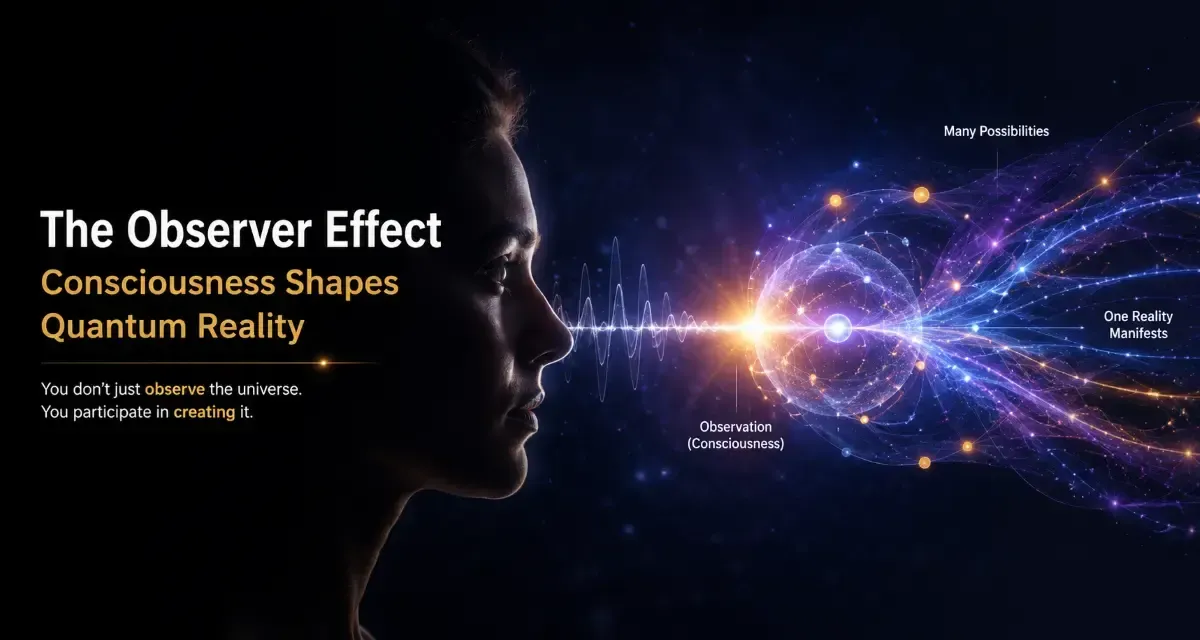
The Observer Effect: How Human Consciousness Shapes Physical Reality at the Quantum Level
There is a moment in quantum mechanics that has never been fully resolved — a gap at the heart of the most successful theory in the history of science. It is the moment when a quantum system, existing in a superposition of all possible states, becomes one definite state. It is called wave function collapse. And the question of what causes it — whether the act of observation, the gaining of information, or perhaps consciousness itself — remains one of the most profound open questions in all of physics.
The observer effect is not a philosophical speculation. It is an experimental fact, confirmed thousands of times in laboratories around the world. The act of obtaining information about a quantum system changes the behaviour of that system. What has not been resolved — and what sits at the intersection of physics, neuroscience, and philosophy — is the precise nature of "observation": what it is, what it requires, and whether the conscious experience of a human observer plays any fundamental role in it.
Exploring this question takes us to the most fascinating frontier in science — and ultimately, to a new understanding of who we are and how we relate to the reality we inhabit.
The Observer Effect: What the Experiment Shows
The observer effect was made famous by the double-slit experiment, discussed in depth in our previous post on quantum reality. To summarise its most startling aspect:
When electrons are fired at a double-slit screen without any measurement device active, they produce an interference pattern — behaving as waves and apparently passing through both slits simultaneously.
When a measuring device is placed at the slits to detect which path each electron takes, the interference pattern vanishes and particles behave classically — passing through one slit or the other.
Most remarkably: even if the detector is present but switched off so that no information is actually recorded, the interference pattern returns. The critical factor is not the physical presence of the device — it is whether information about the particle's path exists anywhere in the universe.
This has been extended in the delayed-choice experiment (proposed by John Wheeler in 1978, experimentally confirmed multiple times): the choice of whether to measure which-path information can be made after the particle has already passed through the slits — and the particle's past behaviour retroactively conforms to the choice made in the future. If no measurement is made after the fact, it passed through both slits as a wave. If measurement is made, it passed through one slit as a particle — and this determination appears to apply backwards in time.
"No elementary phenomenon is a real phenomenon until it is an observed phenomenon." — John Archibald Wheeler, physicist
The Measurement Problem: Physics' Greatest Unsolved Question
At the heart of the observer effect lies what physicists call the measurement problem: quantum mechanics perfectly describes the evolution of quantum states through the Schrödinger equation, which is deterministic and continuous. But when measurement occurs, the wave function collapses to a definite outcome — a process that is discontinuous, probabilistic, and not described by the Schrödinger equation itself.
What causes this collapse? How does a quantum superposition become a single classical outcome? This question has generated multiple competing interpretations, none of which is universally accepted:
Copenhagen Interpretation: The wave function is a tool for calculating probabilities, not a description of physical reality. Collapse occurs when measurement is made, but the interpretation deliberately declines to specify what "measurement" means in physical terms. ("Shut up and calculate.")
Many Worlds Interpretation (Hugh Everett, 1957): The wave function never collapses. Instead, every quantum event causes the universe to branch into parallel branches in which each possible outcome is realised. There is no collapse — all outcomes happen, in different branches of reality.
Consciousness-Causes-Collapse: A minority but mathematically serious interpretation (associated with John von Neumann, Eugene Wigner, and others) proposes that wave function collapse requires conscious observation — that the subjective experience of a conscious observer is the physical process that converts quantum possibility into classical actuality.
QBism (Quantum Bayesianism): Wave functions represent an agent's beliefs about the outcomes of their measurements, not objective features of external reality. Measurement is an action taken by an agent that changes the agent's expectations — not a physical collapse of an objective wave function.
Relational Quantum Mechanics (Carlo Rovelli): The quantum state of a system is not absolute, but relational — it is defined relative to a particular observer. Different observers may assign different quantum states to the same system without contradiction.
Each of these interpretations makes identical empirical predictions — the experimental data cannot currently distinguish between them. But they have radically different implications for the role of consciousness and observation in constituting physical reality.
The Consciousness-Reality Interface: Research at the Frontier
While the mainstream physics community generally treats consciousness as irrelevant to the measurement problem (preferring decoherence-based accounts of apparent wave function collapse), a number of serious scientific research programmes have explored the direct relationship between human consciousness and measurable physical outcomes.
Princeton Engineering Anomalies Research (PEAR)
From 1979 to 2007, the Princeton Engineering Anomalies Research laboratory conducted rigorous controlled experiments on the effect of human intention on random physical systems — specifically, electronic Random Event Generators (REGs) that produce sequences of random 0s and 1s based on quantum noise processes. Over 28 years and millions of trials, PEAR documented statistically significant deviations from chance in REG outputs when operators attempted to mentally influence them — with effect sizes small but reproducible and statistically robust. A comprehensive meta-analysis of REG research across 68 independent investigators produced results with odds against chance of approximately 35 trillion to one.
Global Consciousness Project
An extension of PEAR's work, the Global Consciousness Project operates a global network of REGs continuously recording random data. Statistical analyses have found that during major global events that engage millions of minds simultaneously — including September 11, the 2004 tsunami, and major elections — the network shows deviations from randomness statistically unlikely to arise by chance. The implication (contested, as all frontier research should be) is that collective focused human attention may produce measurable physical correlations across dispersed physical systems.
Intention and Biological Systems: IONS Research
The Institute of Noetic Sciences (IONS), founded by astronaut Edgar Mitchell, has conducted and sponsored research on the effects of intentional mental focus on biological systems — including bacterial growth rates, plant germination, enzyme activity, and human physiological parameters. Multiple peer-reviewed studies have documented statistically significant effects of focused intention on these biological outcomes, suggesting that consciousness may be capable of influencing physical and biological systems through mechanisms not yet fully understood by classical science.
Quantum Zeno Effect: How Observation Freezes Quantum States
One of the most elegant demonstrations of the observer effect in a controllable system is the Quantum Zeno Effect — named after Zeno's ancient paradox about motion. In quantum systems, frequent observation (measurement) of a quantum state can prevent it from evolving — effectively "freezing" the system in its current state through repeated measurement.
Experimental confirmation of the Quantum Zeno Effect demonstrates that the rate of observation — not merely its presence — affects quantum system evolution. This has been proposed as a potential mechanism through which sustained, focused mental attention might influence the quantum processes underlying neural function — a theoretical framework explored by physicist Henry Stapp and neuroscientist Jeffrey Schwartz in their model of attention-driven neuroplasticity.
Neuroplasticity and the Observer: How Attention Reshapes the Brain
Whatever the ultimate resolution of the quantum measurement problem, one thing is established beyond scientific dispute: attention and intention reshape the physical structure of the brain through the well-documented mechanism of neuroplasticity.
The brain's neural architecture is continuously modified by experience — by where attention is directed, what is practised, what is thought, and what is felt. This is not metaphorical. Attention drives the selective strengthening of neural circuits (long-term potentiation), the pruning of unused pathways, and the generation of new neural connections. Research by neuroscientist Jeffrey Schwartz has documented how directed mental attention can produce measurable changes in brain metabolic patterns in OCD patients — changes comparable to those produced by medication — through a protocol of conscious self-directed attention alone.
In this sense, regardless of one's position on the deeper metaphysics of consciousness and quantum collapse, the observable fact is clear: where and how you direct your attention physically reshapes your brain. The observer is not passive. The act of conscious attention is a creative, physically real act — one whose biological consequences accumulate over a lifetime.
You Are Not Separate From the Reality You Observe
The observer effect, the measurement problem, and the evidence for intention-reality interactions all point toward a picture of human consciousness that is fundamentally different from the passive spectator assumed by classical science. Whether through quantum mechanical mechanisms, psychoneuroimmunological pathways, neuroplastic brain remodelling, or biofield interactions, the consciousness that observes, attends, and intends is not a viewer of a fixed, independent reality.
It is a participant. It is, in ways that science is only beginning to articulate, a co-creator.
The frontier question of the 21st century is not whether consciousness influences reality, but how — through which mechanisms, at which scales, and to what extent this influence can be understood, cultivated, and responsibly applied for human flourishing.
Harnessing Quantum Potential With AFT Quantum Wellness
At AMwell USA, the science of quantum observation, intention, and energetic coherence forms part of the foundational thinking behind our AFT Quantum Wellness technology. We believe that supporting the body's quantum environment — its bioelectric field, its frequency coherence, and its resonance with the forces that organise biological life — is one of the most meaningful contributions we can make to human health.
You are not a passive receiver of a fixed reality. You are an observer, a participant, and a creative force. Our products are designed for those who understand this — and who are committed to bringing the best of themselves to the extraordinary act of being alive.
